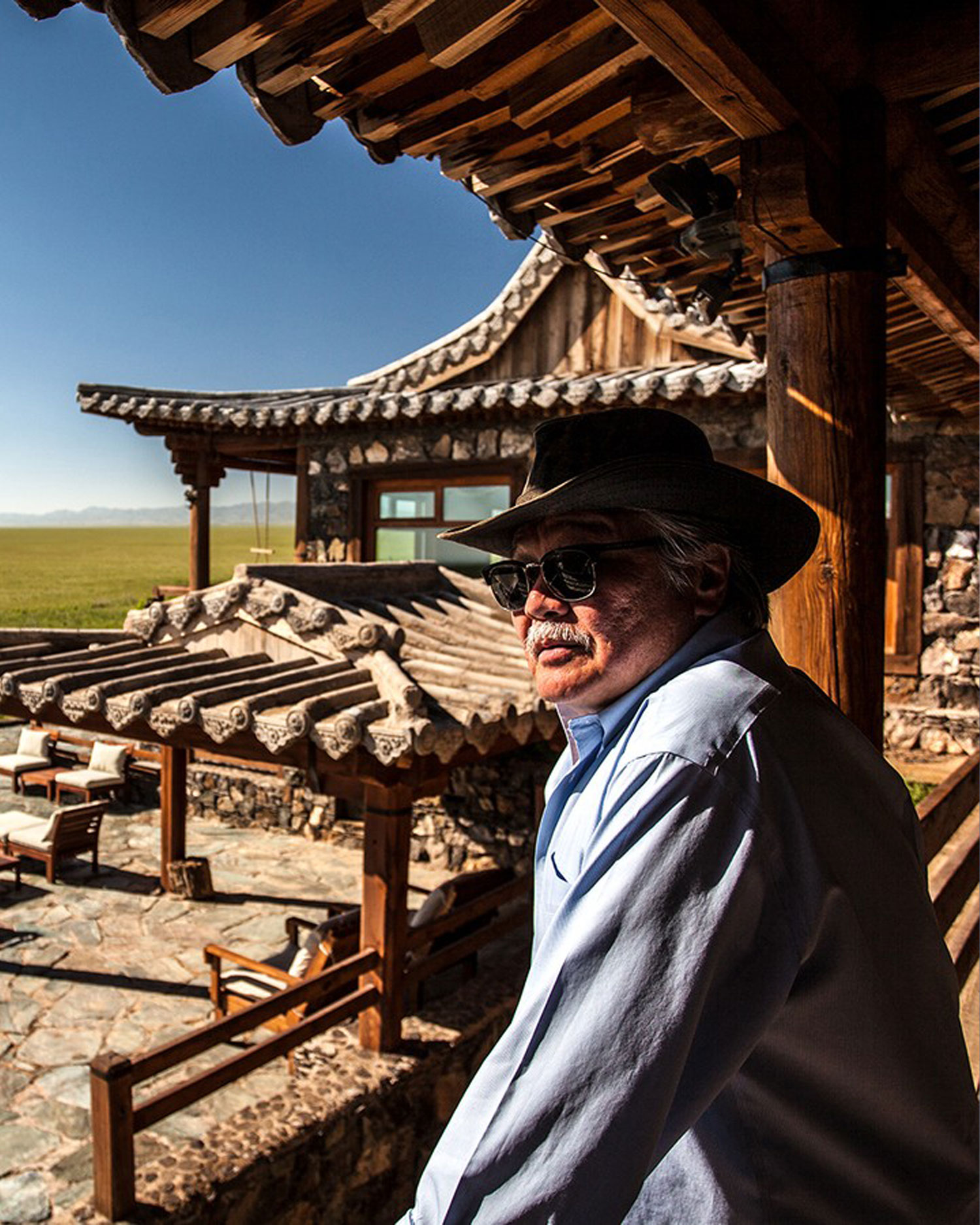

Mongolia’s Gobi Desert has long been a cradle of paleontological discovery. Its wide horizons and layered rock formations hold the history of entire worlds. In 2025, that story grew richer with the formal description of Duonychus tsogtbaatari, a mid-sized therizinosaur whose fossils were uncovered only a few hundred kilometers from the Three Camel Lodge.
Although the fossil was first discovered in 2012 during the construction of a water pipeline near the Oyu Tolgoi mining site, it took more than a decade of research before scientists could fully study, compare, and describe the skeleton. That lengthy process is common in paleontology because researchers must examine every preserved bone, understand how it relates to other species, and confirm whether it represents an entirely new genus. In 2025, a team of international and Mongolian scientists published their findings, officially establishing Duonychus tsogtbaatari as a newly recognized species. The publication brings fresh insight into Mongolia’s Late Cretaceous ecosystems and adds an important piece to the evolving scientific record.
The name Duonychus combines the Greek words for “two” and “claw,” referencing the animal’s unusual two-fingered hand. The species honors Khishigjav Tsogtbaatar, a respected Mongolian paleontologist and former director at the Institute of Paleontology in Ulaanbaatar.
The fossil was recovered from the Urlibe Khudak locality in the Bayanshiree Formation, a landscape shaped by ancient rivers and rich sediment layers of conglomerate, sandstone, and mudstone. The region sits about 320 kilometers (200 miles) from the Three Camel Lodge. A salvage excavation team completed the recovery in only four days, securing one of the most informative therizinosaur skeletons ever found.
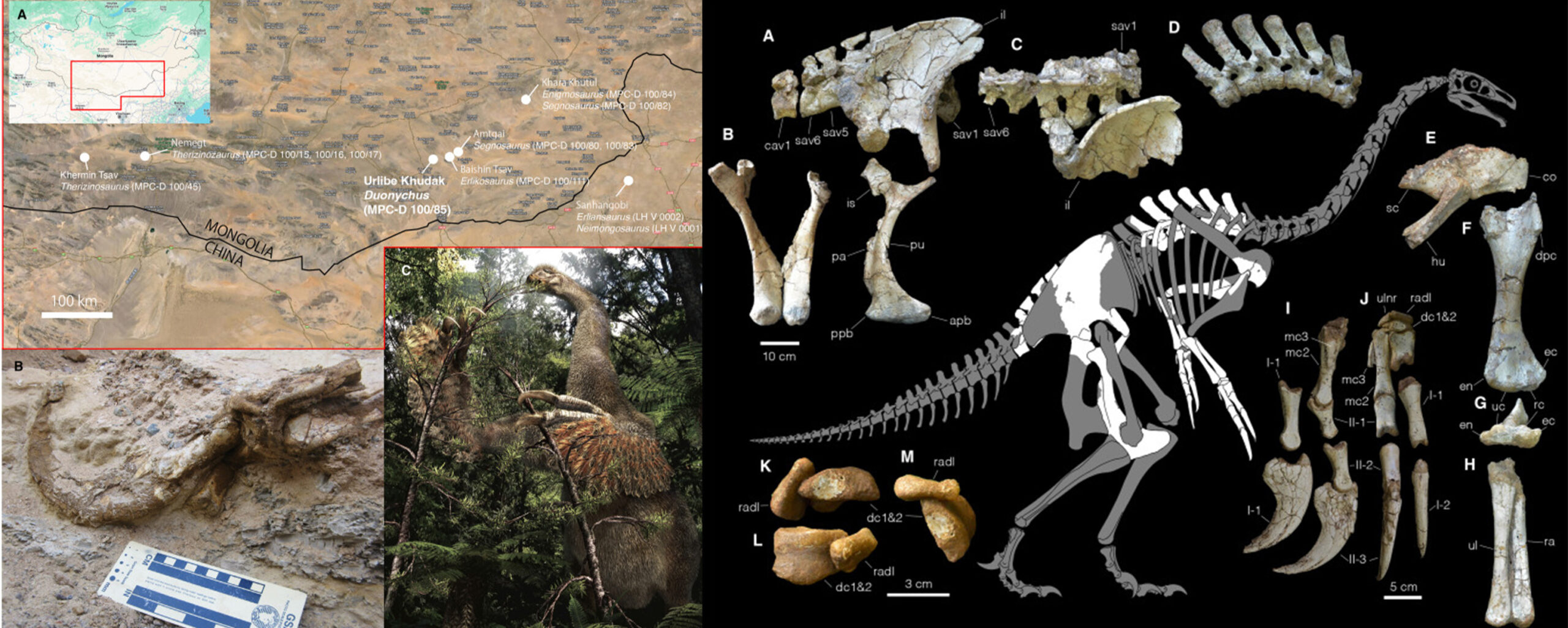
The preserved bones include dorsal and sacral vertebrae, ribs, parts of the shoulder girdle, forelimbs, the pelvis, and both hands. Most remarkable is the fossilized keratinous claw, an extremely rare find. Keratin rarely survives millions of years, so this discovery gives scientists a rare opportunity to understand how these animals used their powerful claws.
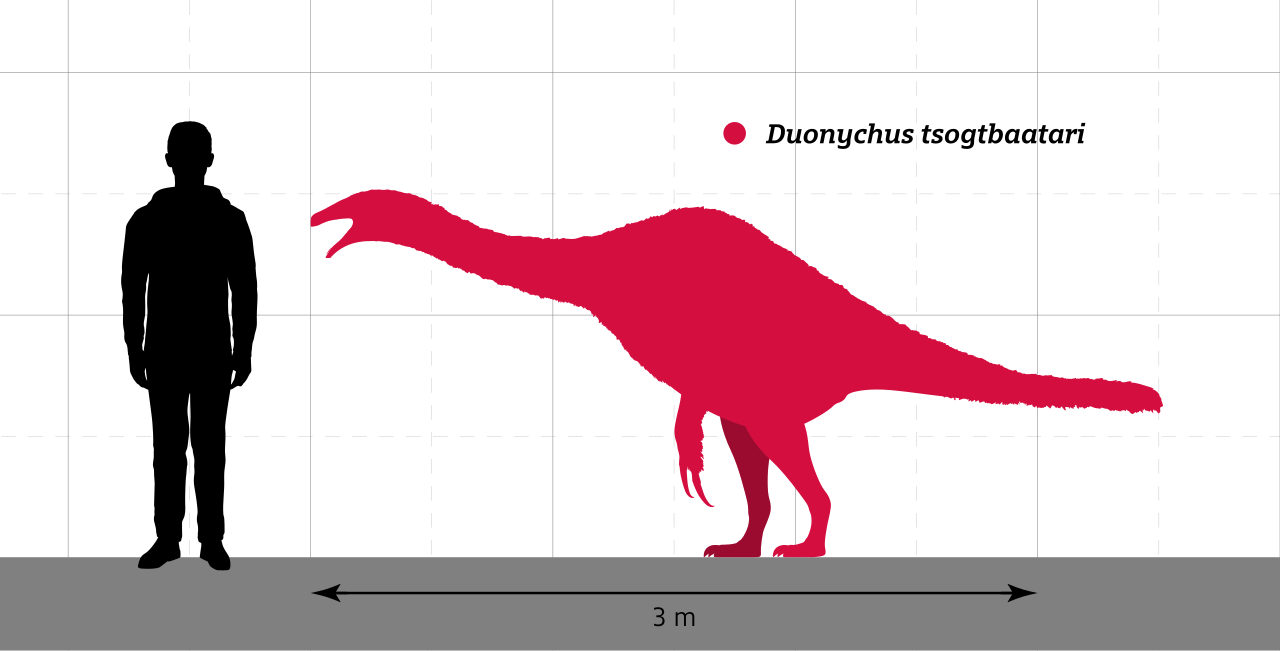
Measurements show that Duonychus was a mid-sized therizinosaur. It weighed approximately 260 kilograms, similar to a large deer, and measured close to 3 meters in length. Despite its size and its sharp claws, it was not a predator. Research shows that the animal used its strongly curved claws to hook and pull vegetation. Its fingers could flex at nearly ninety degrees, giving it the ability to grasp branches up to ten centimeters thick. This suggests that Duonychus fed selectively, choosing specific plants rather than foraging broadly like its larger relative, Therizinosaurus.
For guests at Three Camel Lodge, discoveries like Duonychus tsogtbaatari highlight why the Gobi is one of the most important paleontological regions in the world. The desert is not only a place of silence, starlight, and open landscapes. It is a living archive of deep time where new scientific breakthroughs continue to emerge.

The recognition of Duonychus in 2025 enriches our understanding of Mongolia’s ancient ecosystems and underscores the Gobi’s role as a window into the past. It also offers a powerful sense of continuity. The ground that surrounds the lodge today once supported unique creatures whose stories are still being uncovered, layer by layer.

Plan Your Journey to the Heart of the Gobi
A stay at Three Camel Lodge brings you closer to the landscapes that shaped discoveries like Duonychus tsogtbaatari. Guests can explore fossil-rich regions, connect with Mongolia’s cultural heritage, and experience the Gobi in comfort and style. To begin your journey, contact our team or book your stay through our website.